Wednesday, April 1, 2015

Invading SILAQUI ISLAND, Bolinao: Home to a Million-Strong Army of Giant Clams - the Tridacna gigas

(photo credit: Hector Lillo)
In the many endeavors I would be pursuing from here on end, we will be dwelling on the ideals of ECOTOURISM.  It is a form of sustainable tourism within a natural and /or cultural heritage area where community participation, protection and management of natural resources, culture and indigenous knowledge and practices,
environmental education and ethics, as well as economic benefits are fostered and pursued for the enrichment of host community and satisfaction of visitors.  Such is our ecotour of the town of Bolinao, Pangasinan.  My first marine expedition for 2015 is this visit to Silaqui Island, a barren, thinly populated rock in the northern tip of Santiago Island in the the Lingayen Gulf and within the jurisdiction of the municipality of Bolinao, Pangasinan. Inconspicuous to many, the waters around this island is a marine sanctuary and home to a humongous army of giant clams, the Tridacna gigas.  
The name itself strikes an intimidating impression but on the contrary, these giants are as gentle and docile as a baby.  Seeing these gentle giants in such magnificent numbers, with a population of almost a million is a breathtaking site seldom seen by any individual.  The opportunity to see them up close and personal is something I will not allow to pass since I may not have the chance to visit this place again in the near future.  
I was at the helm of my class of Environmental Science students of De La Salle University Dasmarinas on a scoping exercise for our class in Environmental Impact Assessment.  We were all excited in this trip because Silaqui Island is not your typical usual site for a vacation.  We will later find out  why.  However, since this is an educational field trip and not primarily for pleasure, I will be narrating the events in a more informative and educational way. I hope that this story will give justice to the field trip as an in-situ exercise for EIA field studies. 
 The Bolinao Field trip is an itinerary challenge because instead of a 3 days-2 nights tour, I streamlined it to an overnight stay.  We left Cavite at midnight and had 3 stopovers along the way where we intend to have breakfast at Alaminos, Pangasinan.  We have 2 Toyota vans and the travel was relatively uneventful.  However, we arrived too early in Alaminos and decided to continue on to Bolinao and have our breakfast there.  
The municipality of Bolinao is a quaint backward town in the southern tip of Lingayen Gulf.  It has no popular business establishments for burgers, pizza, medicines, theaters,milk teas and coffee.  But I prefer it this way because the place still retains its rustic identity and that this undeveloped nature itself preserves and protects it from the damaging effects of urbanization and exploitative claws of business enterprises.  
Saint James the Great Parish Church, a Catholic church is the most prominent historical marker in the town square.  Beside it is the Bolinao Museum which is currently closed at the moment. Religious statue of the Blessed Virgin Mary and Saint James humbly stands fronting the churchyard.  The next day before our departure, we will be returning to this place to buy some pasalubong items for our loved ones back home.
After breakfast, our next stop was the Bolinao Marine Laboratory where we were oriented with the breeding program of Tridacna gigas, "the giant clam".  The facility is operated by the University of the Philippines-Marine Sciences Institute and primarily used by UP students but can also be used by other researchers from different institutions which have a formal arrangement with UP.

These are dried specimens of different species of giant clams. Much as we would like to ask or buy the shells for souvenirs, we were politely reminded that it is best just to marvel at the sight of these humble creatures and just take pictures of them as souvenirs as these gentle giants are propagated to be used for seeding in coastal areas which are in dire need for rehabilitation.
We were led next to the outdoor hatchery of the facility where they raise and nurse in-vitro corals, sea cucumbers and of course, giant clams.  
They draw salt water directly from the sea which they use to nurse the young ones in a closely monitored environment.


The marine laboratory is also actively involved in coral reef restoration thru in-vitro culturing of corals.  The tank here shows young corals in a nursery being propagated and when they have reached a particular age of maturity, they will be transferred out in the sea to allow them to establish a foothold on the seabed and propagate naturally.
Another project that the UP-MSI is actively engaged in is the breeding and culturing of sea cucumbers such as this one I am holding.  These crawling creatures also have a very important role in the ecosystem and economic value as its meat is highly sought as a culinary delicacy especially the Chinese, who strongly believed in its medicinal properties.  Did you know that sea cucumbers are one of the few animals that are not afflicted with cancer?  Hmmm.  That's the very reason why they are harvested from the sea.  Not primarily for food but for its therapeutic properties.  However, indiscriminate harvesting of these gentle crawlers has started threatening their existence.  If we do not implement programs on the management of this important marine resource, we may never have the chance to maximize its potential in finally eradicating the deadly disease that has eluded a permanent cure. 
Now it's time to head out into the open sea for an up close and personal encounter with the giant clams.  We were led thru the dressing room where a wide array of diving equipment are stored and used by researchers whenever they are conducting field studies in their respective areas around Bolinao bay.  There was one researcher who was busy preparing for this morning's dive.


The adjacent room here is where they fill up the breathing tanks with compressed air.  Contrary to many people who are not into diving, the breathing tanks are not filled with pure oxygen as this gas is actually toxic when taken pure.  It's even combustible when exposed to open flame especially when it's pressurized.  It's only filled with ordinary air that is pumped thru this compressors and fills the tank to a specific pressure.
   We actually went out first on a countryside tour of Patar, which is another part of Pangasinan, where we enjoyed bathing on a long stretch fine light brown sand that glistens white under the sun, so when taken by a camera it creates a white sand appearance on the picture. But that story will be featured in the next blog I will be writing.  Anyway, here we are on the second day, early in the morning ready to cast off for Silaqui Island.  I decided to change the boat ride for the next morning so it would not be too hot while out in the sea.  The Research Assistant, Mr. July Koreano of the Bolinao Marine Laboratory gave a short orientation on the do's and don'ts while snorkeling in the marine sanctuary.  After the briefing we had our posterity shot and casted off!  Everyone was excited in this trip, even Hector Lillo of Exploria Tours was eagerly excited to see the giant clams as well.
The journey to Silaqui Island is not a straight path but the boat had to navigate its way through the shallow waters of the bay along a navigational path free of corals and submerged fishpens.  Much of the bay is actually used for marine aquaculture for growing milkfish or "bangus" and other economically important fishes. 
Some areas are being used for a variety of underwater research so the boatmen have to be very careful in avoiding this places otherwise the set-up might be disturbed and the data being collected might be ruined.   
Finally, Silaqui Island is on sight, everyone aboard is excited as a seafarer very eager to reach land after spending several months at sea.  We had seen a couple of live clams back in the laboratory but this time we will be seeing more than our eyes can feast on.  Even our Hector Lillo, our tour guide from Exploria tours is as eager to jump in the water and swim up close with the clams.  He shared with us that not long ago when he visited Coron, Palawan, giant clams can be seen while diving and locals would always bring one clam to the surface for picture taking and eventually be sold to the tourists for eating.  Gone were those days now because you won't see a single giant clam in Coron anymore.  Such is the terrible impact of tourism in that beautiful place but if the practice still continues, there won't be any marine creature to gaze on while diving.  That is why tourism should focus first on minimizing the impact to the ecosystem before addressing customer satisfaction or else there won't be any place left for the tourists to visit.
When we finally reached ground zero, there was no need to persuade everyone to enter the water, everyone got their gear on and began to swam in all directions.  There was a feeling of euphoria in the air as the moment cannot easily be described in words as the magnificent sight of the silent giants came into view.
There is a portion where an in-situ nursery for young clams are placed and as soon as they reach their size of maturity, they would be transferred out of the basket and will be allowed to assimilate with the general population.  For now they have to be monitored inside the basket where they enjoy some protection from predators.
This is what these beautiful creatures look like up close.  Their anatomy looks like a landscape from an alien planet with all those bright neon colors to attract prey and the texture so weird it will make you hesitate to touch them.

Aside from the giant clams, there are also sea stars and sea urchins roaming around.  The sea bed has indeed started to succeed as a stable ecosystem as the biodiversity of different marine species begin to increase.
This is a full view of the giant clam with the two orifices visible.  Did you know that these bivalve mollusks are hermaphrodite, meaning that the two sexes, male and female are present in a single organism. Very interesting trivia indeed for a layman.
This is the close up of the genital orifice of the Tridacna gigas. Many science-fiction movies were inspired from the volcano-appearance of orifice of these creatures that can really induce a spine-tingling effect of an audience.
These spectacular underwater pictures taken from a Canon digicam fitted inside a Canon waterproof casing would not have been featured in my blog if not for the shots of my good friend and an experienced dive enthusiast Hector Lillo from Exploria Tours who facilitated this trip to Silaqui Island.  For your touring needs in and around the Philippines, you can contact him thru https://www.facebook.com/exploriatours
To cap the underwater excitement, one of the boatmen brought a giant clam up to the surface for us to have a selfie shot with the gentle mollusk.  The boatman cautioned us not to insert your hand or finger in between the shell to avoid the unexpected to happen.  The selfie moment was a memorable experience indeed.  It also gave us a clear picture of how big the bivalve is.  There is even a coral attached to the hinge part of the clam.
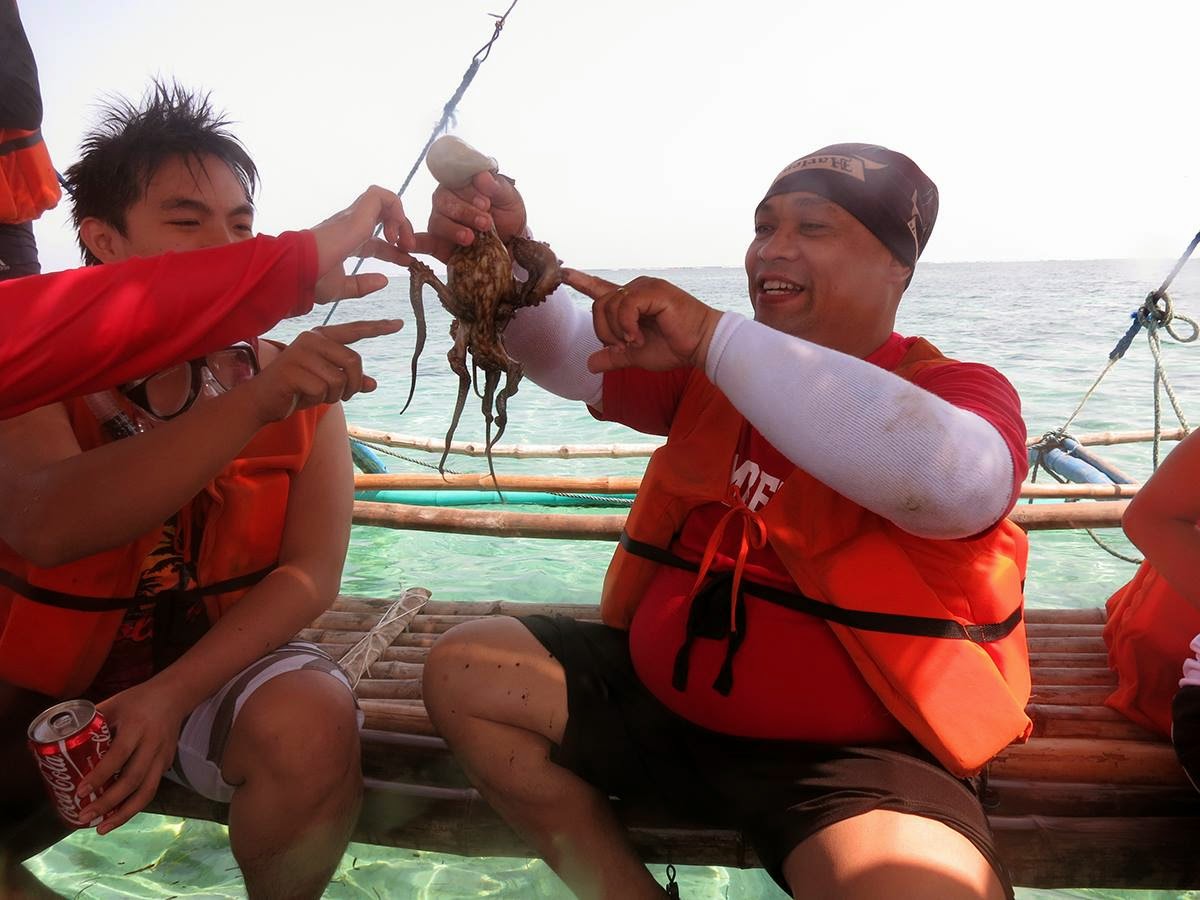
The boatman also caught a small octopus and apparently the poor mollusk will end up on the boatman's family dinner or drinking session.  The boatman who is also a fisherman did not fish for today but instead used his boat to ferry us so this is probably his only catch for today.
After a tiring but exciting time snorkeling with the giant clams, we decided to drop anchor and explore Silaqui Island.  The group upon landing looks like a crew from a shipwreck marooned on a deserted and barren island.  Our first impression was not of excitement but of disappointment when we realized there are no white sand beaches along the entire circumference of the island.  Nothing but barren rocks, jagged cliffs, shallow coast, grassy seabed, sharp spiny dried brushes of vegetation.  All scenes of desolation as the beach is littered with carcasses of sea urchins, shells and even a cat skeleton who probably died of starvation on this barren rock.
This is the view atop the northern end of the beach where you can see the dried vegetation in the foreground.  It was very difficult and dangerous trying to reach this spot because the ground was jagged volcanic rock that a careless trip will surely result to a nasty gashing wound on your foot.  The brushes are so dry and spiny that our clothes always got caught and almost torn away while pushing our way into the dense brushes.  We don't have a bolo to whack around the bushes and blaze a trail to the top.  After having a few shots, we just went down again and explored the other end of the beach as well.
At the other end of the island where jagged cliffs abound, my students were looking for a spot to do some serious cliff diving.  Unfortunately with all the cliffs around, there wasn't a single spot deep enough to jump in.  Anyway, still eager to try, one of my students Jerry, was bold enough to jump in.  You can just imagine hearing the laughter of everyone when he landed on knee-deep water.  What a bummer!
Silaqui Island is a rock whose coastline had been eroded by the continuous pounding of the waves until these undercuts were formed along its rocky base. 
 The best thing we probably did in this island was just to admire the natural undercuts like these where eventually a cave can be formed thru the years.  But that would probably take another thousands of years for natural wave action to cut through the rock deep enough to form a cave.
We have learned a lot from this visit to the marine sanctuary of the Tridacna gigas.  Swimming up close and personal with these gentle giant molluscs and seeing their increasing numbers grow to such extent is a promising sign of hope that there is still a chance for us to restore the beauty and natural wonder of the sea especially that our country the Philippines is known worldwide as as the "Center of the Center of Marine Biodiversity"!  We owe our thanks to the dedicated marine biologist in the Bolinao Marine Laboratory for their passionate and zealous efforts to help coastal municipalities in capacitating themselves to practice sustainable marine and coastal resources to ensure that future generation will still have the opportunity to enjoy nature as it is supposed to be.  Wild and Free!  Judging from the smiles of my beautiful students, despite the tiresome schedule, this trip is definitely one for the books!
Swimming up close and personal with the giant clams is just one of the many adventures we had in this Bolinao environmental field trip.  We still have lots of stories to tell in my other blogs, so feel free to visit my blogsite and read all the stories of my adventures of different places, people and wildlife! Till next time this is your DocFun-the Doctor of Fun and Adventure!


Tuesday, October 28, 2014

CHARC-HAULERS OF WAWA: The Frontline of Deforestation in Rodriguez, Rizal


What was supposed to be a trip down memory lane of my childhood in the laid-back town of Rodriguez (formerly Montalaban) became a traveler's reality immersion of the sad state of neglect in the impoverished sitio of Wawa.


The first time I visited this beautiful place was during my growing up years as a child in the closing years of the 1970's.  Martial Law was at its zenith and is on its descent towards eradication.  My Dad being an avid historian, often brings the family here because of his fascination of the historical if not the mythological significance of the twin peaks cleaved by millions of years of hydrologic attrition and eventually shackled by a seemingly impregnable anthropogenic structure built during the American era which today proudly stands as the symbol of the town's entrance arch that greets incognizant visitors.


As a child, my primal interest is the Wawa river with its crystal clear water teeming with small 3-inch freshwater swordfishes fast swimming against the rapid current of the river.  I would immerse myself in overwhelming joy as I set the boundary of my territory, picking out a cool spot surrounded by boulders deep enough to frolic and attempt to catch fish.  All of these are gone now as the water became murky due to the establishment of animal farms upstream and the accelerated the rate of erosion and siltation of the river due to deforestation caused by pressures of a growing population upstream,


But still the main attraction of the place is the Wawa Dam, a weir dam where there are no floodgates and water freely overflows on the top when it reaches the brim.  It was built by the Americans during the period when the Philippines, a colony of Spain was turned over to the Americans.  Its purpose is to serve as the main source of potable water for Manila.  When the liberation of the Philippines was underway in the closing years of World War II, the retreating Japanese entrenched themselves in the rocky  terrain of the gorge and was one of the last Japanese stronghold to surrender at the end of the war.  The dam is an environmentally controversial structure because of the environmental impacts it creates when large tracts of virgin forest is submerged in order to store huge volume of water but this is just one of the many necessary evils that we have to live with in order for human life to fluorish.  The Wawa Dam has long been abandoned ever since the La Mesa Dam took over its role as the main reservoir for the Greater Manila Area but government planners are still eyeing the structure as an option in response to the looming water crisis in the years ahead. 


A brief trek to the dam will make you realize that the place is far from being ideal as a tourist destination nor has it changed the way of  life of its inhabitants.  After more than 40 years since I last set foot on this place, I was expecting a more urbanized, developed place where toursim should have uplifted the lives of the people here.  Sadly, things have changed for the worse.  Life was simple way back then.  People were not well-off during those times, but you don't feel an atmosphere of depression among the local inhabitants. 


But today, there are more makeshift dwellings, more people, obviously no systematic drainage, sewerage and septic system and unpaved roads giving you a clear image of what it looks like when the ground is soaking wet with mud.  Before reaching the dam, the jubilant feeling of excitement and anticipation of seeing the dam was extinguished by an atmosphere of depression and pity towards the residents of the place.  Children were gambling with coin games, men just drink in front of their shanties unperturbed by our presence as we passed by and wet markets abound the place where their effluents simply trickle across the road and into the river.   

   
Despite the ugly revelation of the place, the scenery still captivates visitors who will not let the chance to pass and will still stop on several occasion to take a picture of a beautiful scene.  However, when stopping to take pictures especially along the cliffside path that was carved out on the vertical wall of the mountain, you will find yourself repeatedly pulling over to the side of the cracked pavement to make way for a non-stop parade of downhill or outgoing apparently minor and adult men —each one hauling enormous bundles of charcoal over their backs or heads. The loads look precariously fastened on, but the "Charc-haulers" as I call them, navigate the winding, often muddy and slippery terrain at a fast, steady, deliberate pace. These charcoal-haulers are coming from the front lines of Rodriguez's worsening deforestation epidemic, and they will travel great distances with their burden to the nearest market hub, where they'll sell each bundle for a meager amount enough for a day's  hand-to-mouth sustenance.   


The deluge spawned by Typhoon Ondoy in the Marikina Valley on the fateful day of September 26, 2010 was attributed to the rains that had concentrated its downpour in the mountains of Rodriguez and San Mateo. The two towns of Rizal are undoubtedly the sites of the biggest gravel and sand quarry that provides much of Greater Manila's construction needs,  They are also the sites of the biggest landfills that receive the bulk of Metro Manila's refuse.  All these conditions together with the fact that the mountains around it are denuded is the perfect formula for a disaster.  When I last visited the place in 2007, charcoal was not the main livelihood of the people back then but rattan hauling, which is still abundant in the mountains.  But when rattan population declined due to rampant harvesting and the DENR started enforcing a ban on rattan extraction, people resorted to charcoal-making because it passes scrutiny by government regulators simply because they are not carrying lumber out of the forest.   


The burdensome hauling of these notorious global warmers occurs only after the men create the charcoal themselves, and package it up. That entire process includes felling the trees, chopping them up, burning them in a kiln, and acquiring rice sacks to hold the charcoal.  After which they transport it downstream via bamboo rafts where they disembark at the Wawa Dam and start the downhill hauling on their back or heads with 2-3 sacks per person in one trip alone.  


The cycle of destruction continues upstream as the trees ran out in a particular place, the charcoal makers gradually move upstream where there is still fresh supply of trees and subsequently, the travel distance and time takes longer than before.  I do not have any statistics yet on this trade, but I feel that a huge percent of the immediate local population earn their income from this way of life.


We are all guilty of allowing this trade to fluorish because of the demand that we create if we eat charcoal-cooked food whether we cooked the food ourselves or order charcoal-grilled food in our favorite restaurant.  A huge percentage of Filipinos still patronize charcoal cooking.  Almost everyone buys it in the market because its the cheapest and most readily available cooking fuel. And it's that demand for charcoal that's feeding the plague of deforestation in Rodriguez or anywhere throughout the country, where thick forests are razed at an increasingly alarming rate just for the charcoal alone.


The people of sitio Wawa have long been suffering from poverty and it doesn't seem that the local government is providing an alternative source of livelihood for these people in order for them to deviate from destroying their very habitat.  But instead, insult was added further to injury when we were completely beset by an olympic-size swimming pool constructed smack in the middle of the path leading to the dam. I do not know the rationale for this swimming pool whether this is the solution to the poverty plight of the people or just another folly of a politician trying to gain the votes of the less-informed majority.  At this point, whatever its purpose will be, the children are enjoying playing in this empty pool for the moment together will all the safety risks that its slippery tiles poses on the unmindful youth.


The Wawa Dam is not a hopeless case.  The beauty that emanates from the dam and the surrounding forest is still enough to captivate and satisfy a yearning eye for nature.  It can be restored and developed and can even outmatch Villa Escudero in terms of its awesome power, huge boulders and a picnic haven for tourists, local and foreign.  The local government should see that the natural resources they have can remain untapped indefinitely for future generations to enjoy by converting it into a nature sanctuary rather than extracting the resources because they already have a gold mine in their hands that is already kissing their very noses and yet are unable to see.  There might be political dynamics that are preventing this from happening but without the political will, it will never come to fruition.


I've long had a lifestyle change in not eating charcoal-grilled foods because it is a scientific fact that many of the burn residues that gets into the food eventually enters our body carrying a variety of toxins that can lead to cancer.  And since I am already afflicted with this life-changing disease, it was hightime for a radical change in my diet.  In a time where the consequences of climate change is slowly revealing itself to us due to the accelerated global warming brought about by our indiscriminate discharge of carbon into the atmosphere, we need to change our mindset toward patronizing charcoal cooking. It needs to be stopped at once.  I remember a anonymous phrase by an apparent environmental activist.  "If you truly care for the environment, be an activist.  It's not enough to say that the river is dirty.  You have to go to the river and clean it up"  In analogy, if we stop patronizing charcoal, we stop the demand.  When the demand for charcoal is gone, the felling of trees for charcoal will stop too! Be active and help stop it!  


Wednesday, May 14, 2014

SCUBABRO - FORMERLY THE OUTRIGGER IN ANILAO, BATANGAS

      Welcome to another adventure in my travel for heath blog site.  This time we we'll be enjoying the summer in  the beaches of Anilao, a diving haven for beginners and experts alike. The rocky shore and rugged seabed of Anilao together with its favorable current promotes a good environment for spawning of marine flora and fauna.  Biodiversity experts consider this place to harbor the richest collection of corals and other marine wildlife than any other place in the world.  Anilao is part of the so-called Verde Island Passage and considered as the "Center of the Center of Marine Biodiversity".

 
       The trip to this place is part of the traditional annual summer excursion of our department where we get to get away and unwind from the monotonous life of teaching and get the opportunity to bask under the sun and dwindle the time away without thinking of work.  The place is very beautiful with a wooden balcony facing the sea and offering a spectacular view of the anilao seascape.  The water is of the sea is very clear but the resort itself doesn't have sandy beach although you can get to one right behind the Cathedral Rock, which os one of their attractions.


Monday, April 28, 2014

COTTA BATO CHURCH RUINS AT CATARMAN - WHY SPANIARDS ARE ATTRACTED TO VOLCANOES

With the many places I've visited throughout the country, it seems that every nook and cranny of the Philippine archipelago has a Spanish presence imprinted in its history.  One of the reasons that I came up with this observation is probably the attraction of Spaniards to volcanoes.  For example, the famous world famous Mayon Volcano in Bicol has a church ruins in Cagsawa. The world famous Taal Volcano has its church ruins in the town of Talisay.  Even Mt. Pinatubo ruined the Bacolor church in Pampanga but residents rehabilitated what's left of it.  Next photo shown is the Spanish bell tower.


According to the historical marker on Cotta Bato's entrance, this town was once a thriving community until the eruption of the volcano wiped out the town and destroyed its church. It makes you wonder why the Spanish friars didn't restore the church afterwards.  There are many theories I came up with.  First. the natives have a high reverence for the spirit in the volcano, so the Spanish priest established a church to dissuade the people from worshiping the volcano god and instead convert to Christianity. Having been wiped out by the volcano in front of the natives, the priests lost face and their influence afterwards.  Photo below is the church convent.

My second theory is probably related to Spanish colonial and spirit of adventurism.  Since Spain was at that time a superpower with expansionist intentions, they fancy places that has a continuing element of danger, for example, the ever-present threat of living near an active volcano.  In this way, their level of alertness is always high in anticipation of a possible uprising from the natives.  Below is a marker narrating the events that took place in 1871 that wiped out the town.

Of course, my theories are open to argument,  but I believe that there is one thing that everyone will agree with me.  And that is, people whether native or foreign simply just cannot resist the beauty of nature that volcanoes can create of a place.  In the aftermath of destruction and violence, a period of succession begins and the end will always come out beautiful and awesome!  So when we arrived in this once devastated place, we took the time to enjoy ourselves in the midst of history.

Despite my size, you can just imagine how small I am beside this humungus, centuries old tree beside the convent.  This is a favorite photo site  of the many tourists that visited this historical place.

The ruins is perched on the high grounds of the island with a navigational vantage point and this explains why an eye-sore like this modern-day light house was erected in a historical site such as this.  The Spaniards did proved that this place has indeed a military purpose.

 This is the perimeter wall or what's left of it, where the entrance to Cotta Bato is located.  This is the only wall left and the other three walls of the square are no longer around.  Beyond this wall, residents constructed a small chapel to retain the reverence of this sacred place. 

 Before departing the place, we took a posterity group picture along the cliffs overlooking the sea.  The view here is spectacular.  The visit to this place is quite interesting for me.  Don't expect too much when visiting this place.  It may be quite simple, but the beauty here is its simplicity.  The purpose of this place is give us a small glimpse of history of how the Spaniards live in simple grandeur in an island paradise such as Camiguin and how God took it away from them.  Until next adventure, I hope you enjoy this story as much as I enjoy its history!


Saturday, April 26, 2014

ARDENT HOT SPRING - NATURE'S HOT TUB OFF THE BOWELS OF MT. HIBOK-HIBOK


Welcome to another adventure in my blog.  I’m here together with my son and we are about to be treated to  a new experience in this volcano island of Camiguin, something you would expect to come out of a volcano – HEAT!  And what’s the best way to enjoy heat without sweating?  Transfer it to water and presto!  You have a hot bath! Courtesy of Mt. Hibok-Hibok Volcano!  

Ardent Hot Spring is one of the attractions in the smallest province of Camiguin.  Groundwater heated by geothermal energy vented by Mt. Hibok-Hibok oozes out into the surface where inhabitants took advantage by containing it in natural pools like this and allow ovrflow water to run-off to the river like this.  To improve the quality of water, the sides where cemented to keep it from turning muddy.  The result is clear, lukewarm water so enticing you want to stay in and laze for the whole day.  
 What made this place cool is the way the developer retained the forest ambiance of the place.  The hot springs in Laguna is already far too anthropogenic.  Even though hot water comes naturally from underground, it is pumped into a swimming pool that is completely covered with ceramic tiles.  However, one cannot blame the owners of hot pools in Laguna.  They are constrained by the sheer volume of vacationers from nearby Metro Manila that prompted them to be more practical in maintaining the cleanliness of the pool by covering it with ceramic tile which makes it more manageable.  Concrete pools like this in Ardent will easily turn dirty when a huge number of people bathed in it all at the same time.

If you were wondering how hot the water is, I'm sure this picture will answer your question.  The water is slightly 1 degree lower to experiencing a high fever.  Immersing yourself in it slowly will immediately give you that sense of sleepiness as the warm water absorbs all the tension in your body and your brain responds by completely surrendering the body to its captivating warm but rejuvenating effect.  I can honestly say as experienced by all the guys out there,  a sudden dip into this hot caldera will make you feel like hard-boiled egg. ha ha ha ha! 

Aside from my son who's in the other pool, this is the entire bunch that's with me.  The girls are my sister and nieces and the guys are my cousin and nephew.  You can just see by the looks in their faces how much they enjoy the natural hot tub here in Ardent Hot Spring.

 Of course being the main character on this story, nothing compares to the exhilaration that this experience has brought to my mind and spirit.  This sure is a stress-buster from me after finishing another school year and just recovering from a major operation as a result of cancer.  The warm water in indeed rejuvenating, relaxing and most of all fun because I may not be able to pass by again this way so have to enjoy this place as if this is the last place on earth.

The rest of the place still has its natural flair with all the vegetation around.  The air is clean, the greenery soothing to the eyes, no traffic around.  No annoying vendors. just simply natural.

 Well, this concludes another adventure in the island of Camiguin.  The adrenaline in these guys sure hasn't gone down yet because we still have plenty places to go before the day's end.  Just as the saying goes, if by chance you may be able to visit this paradise , please do! Please CAMIGUIN! HA HA HA HA!